Tuesday soup at the market hall
Rituals editor · 1 September 2026
On this page
A weekly pot in a civic market is not a restaurant. It is a ritual with a ladle, a list, and a closing time that does not move.
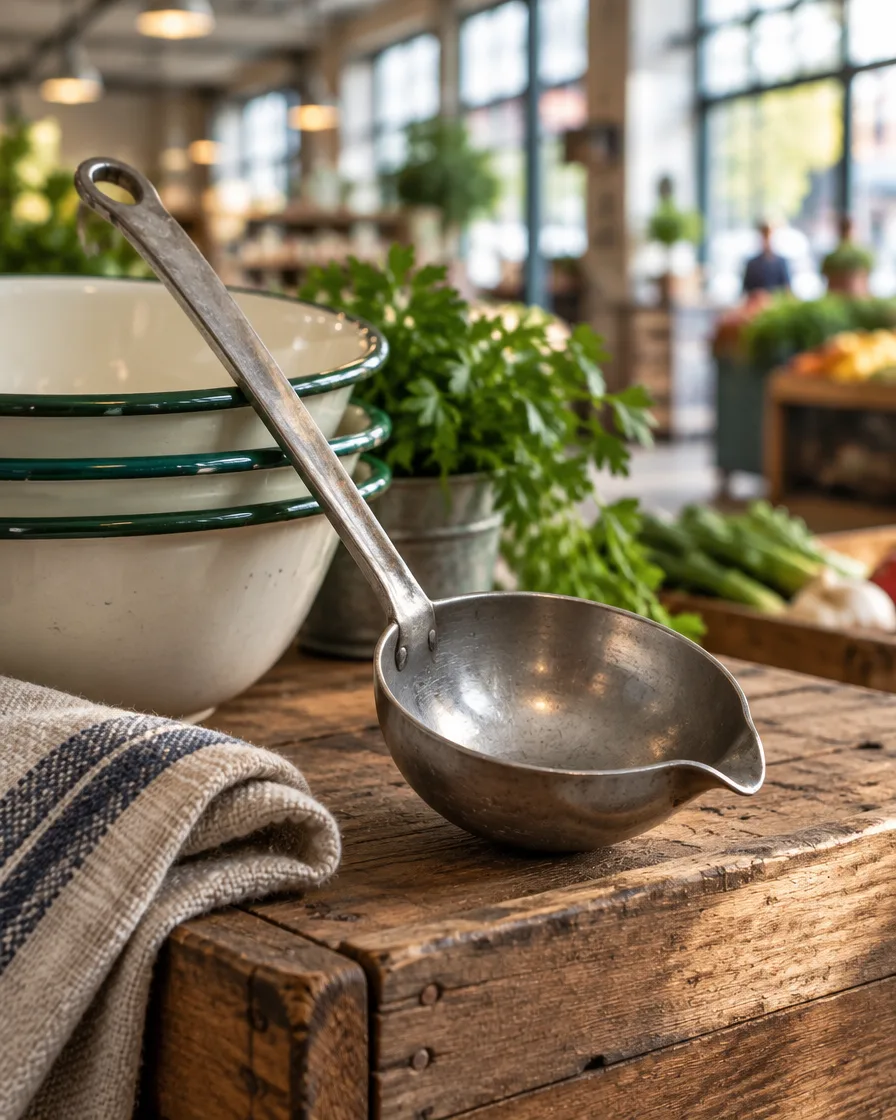
The pot goes on at nine. Ruth Meng will not start later because later means the bones do not give and the hall fills with people who think soup is a pop-up. It is not a pop-up. It is a Tuesday. Traders know to leave a clear metre at the east end of aisle two. The metre is marked with tape that has been replaced so many times it has become a colour rather than a line. Bowls live in a crate that used to hold oranges. The ladle is the only object anyone is precious about. It has a bent lip that pours without dripping on the table ledger.
How a ritual avoids becoming a brand
There is no logo. There was a hand-painted sign for one winter and then it felt like advertising, so Ruth took it down. Information lives on the notice string at the reading room and on a card taped to the hall door: Tuesday, noon to two, two pounds or what you have, no second bowl until the line has gone through once. The prices in this sample are illustrative. Nobody is invoiced. The tin is counted in front of whoever is still wiping tables. Transparency, here, is a physical act.
The pot itself is a borrowed catering pan from the school across the service road. The school wants it back every Thursday for a meal that is not our subject. Ruth’s stock is onions, barley when she can get it, and whatever the stallholders would otherwise throw: carrot shoulders, herb stems, a ham bone from the butcher who still closes for lunch. She can cook without meat. Tuesdays after a holiday weekend are often beans. People complain in the way families complain, which is to say they still eat. Salt is the only argument she will have in public. Too little and the line tells her. Too much and the line tells her. She tastes from a cup, not from the ladle, because the ladle is for serving and she will not make a theatre of the cook.
The line is the room
By 11:40 the line is the architecture. It bends around a flower stall that smells of wet paper and around a man who sells batteries from a suitcase. Regulars leave a gap for the battery man because he was there first. Newcomers have to be taught the gap with a look. Ruth does not speechify. She serves. If someone is unsteady, a volunteer walks the bowl to the bench along the cold wall. The bench is not comfortable. It is enough. Comfort, she says, is how a ritual starts charging extra for the feeling of being good. A child who wants to help is given spoons to dry, not a speech about charity. The spoons go back in the crate. The child learns the weight of the work without being turned into a mascot.
Weather changes the line more than publicity ever could. Rain brings people earlier. Heat thins it and then concentrates it at half past twelve, when the hall is shade. Ruth keeps the same two-hour window anyway. Extending would teach the district that persistence is a way to extract more. She would rather be found reliable than abundant. Traders who finish early sometimes eat standing, then go back to packing. The soup is not their break in a brochure sense. It is food that happens to be in the building they already pay rent to stand in.
Names are handled carefully. Ruth knows many of them and writes none on a public board. A first name is enough for the ladle. If a person wants to be unknown, they can be unknown. The ledger on the table is a tally of bowls, not identities. Journalists who want a tearful origin story are sent to wipe tables. The origin is that people were hungry on Tuesdays and a hall already had a tap.
At two the ladle goes into a jug of water and the tape metre becomes an aisle again. Leftover soup is portioned into the orange crate’s remaining tubs and walked to the night library desk and to Lena at Binder Street. Nothing is posted as a success metric. The measure is whether the pot emptied without anyone being hurried off the bench. Adele Park, who wrote this, stood in the line twice and served once. Serving is slower than reporting. That is why the piece is a ritual story rather than a food review. There is nothing to rate. There is a Tuesday that keeps arriving, whether or not a journal is watching.